|
|
Steadicam - A brief history
In 1972 the Steadicam was developed by camera operator and inventor, Garrett Brown (see http://www.garrettbrown.com/). This idea was very quickly adopted by the film industry and pioneered in such films as The Shining and Rocky.
He was unhappy with unstable nature of handheld camera operation and wanted to stabilise the camera over terrain where a dolly or track couldn't be used. From that moment on, the Steadicam changed the way cameras would move and since then, Steadicam and similar styles of body mounted stabilisation systems have been standard tools on the sets of thousands of films.
Of course nothing is perfect and Steadicam was no exception. It and similar systems had their limitations. They could be used in only two modes; normal and low mode and to switch between modes would take typically 20 - 30 mins which is not ideal when an entire crew are waiting for that to happen. That is until, Howard Smith of MK-V Modular Systems, decided he would design a system to enable him to switch modes instantaneously. The AR-Revolution was born! (See http://www.mk-v-ar.com/)
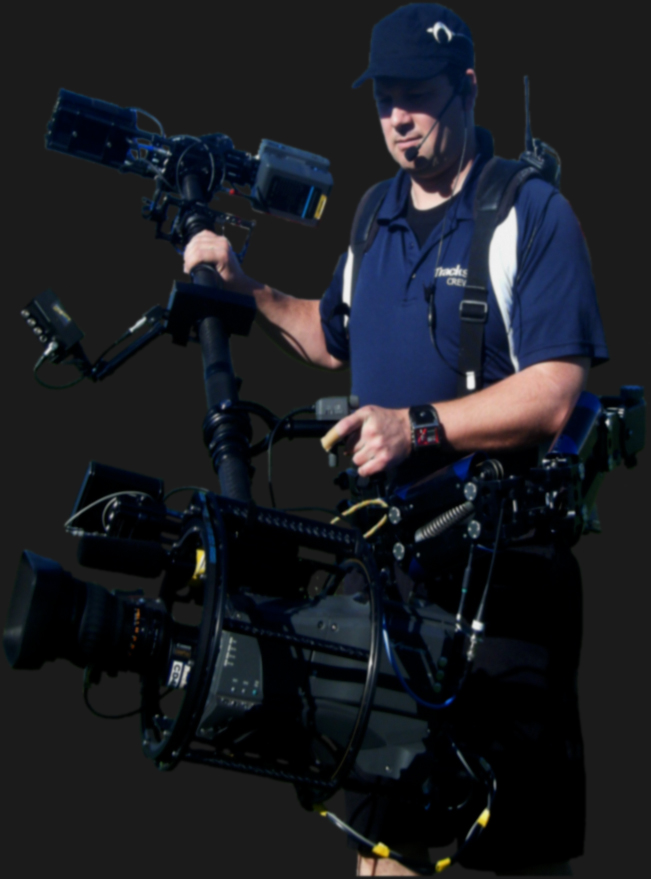
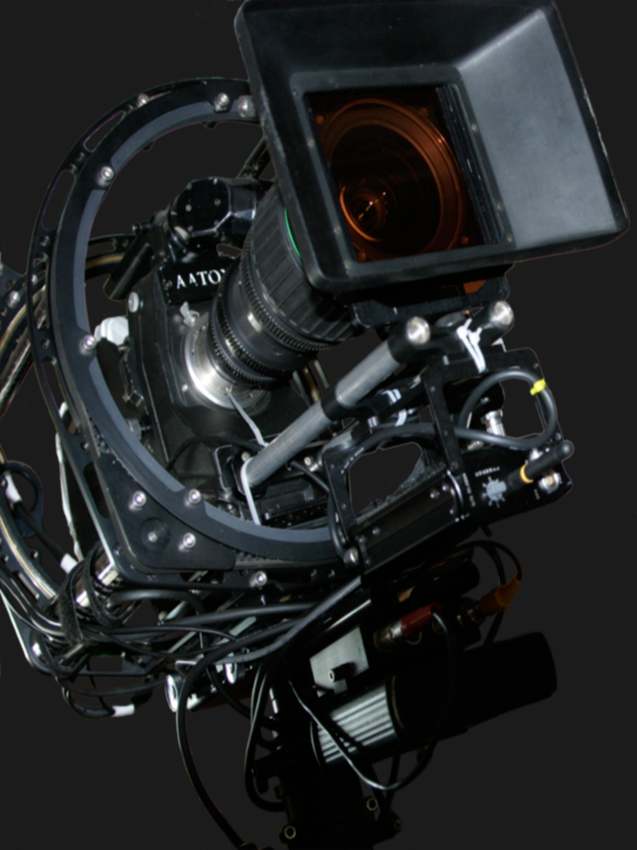
The 'AR-Revolution' (Auto-levelling Revolution) system.
So what can it do?
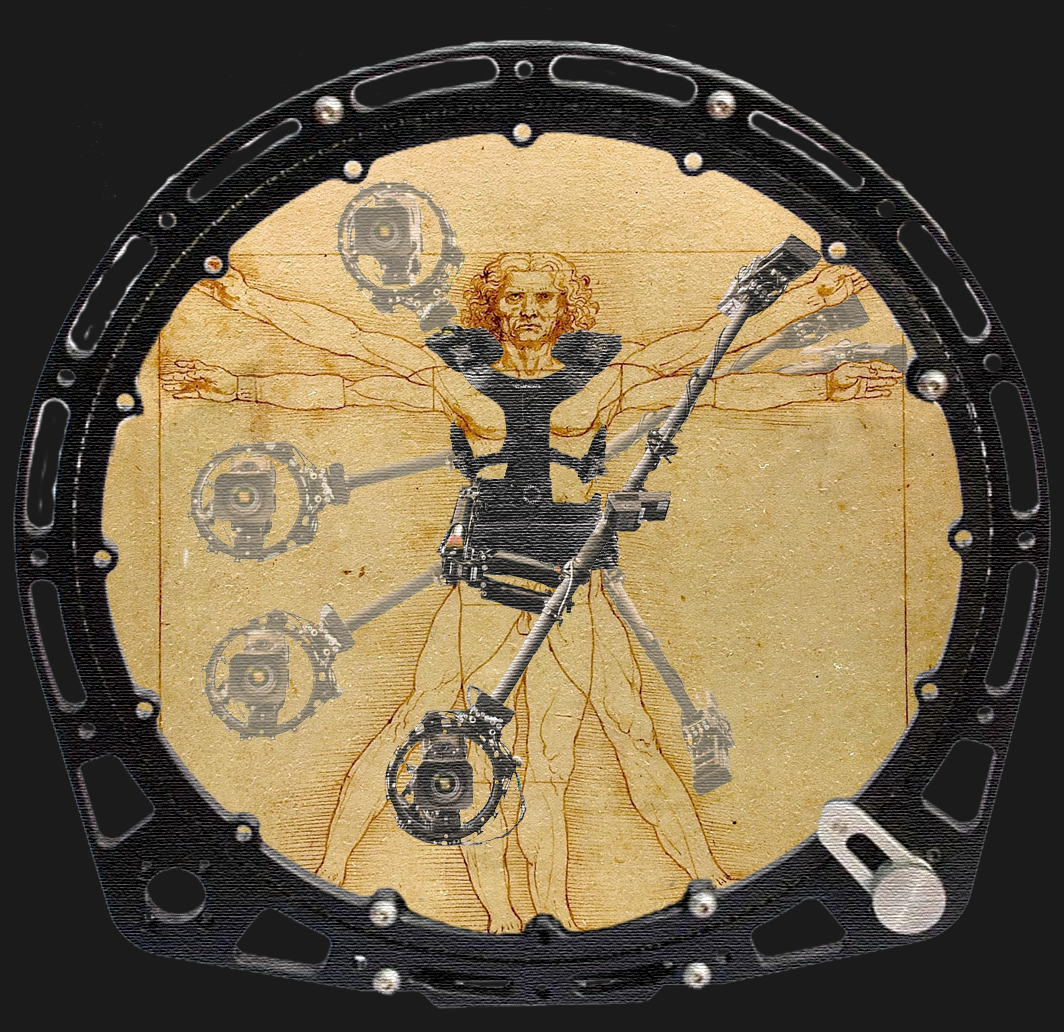
The AR can perform smooth tracking shots just like a traditional Steadicam. However, unlike a Steadicam, the AR's auto-leveling system allows the camera to move from high mode (up to about 8 foot high) to low mode (ground level) in about a second, or as quickly as the operator can humanly flip the rig.
All this while tracking, during the one shot and maintaining a level horizon (or any other preset angle). This is possible because the rig uses auto stabilising engineering, both electronic and software driven.
Because the rig no longer needs to be kept vertical, the camera can now travel sideways, over and under objects. This opens up a new world of exciting shot possibilities. If you can think of a shot angle, the AR can probably get it.
For example, the camera could start inside a car, track out sideways through the open window, across the bonnet of the car, do a 360* rotation around the actor stepping out and finishing at ground level as the actor walks away. The possibilities are endless!
Even relatively simple Steadicam shots are incredibly rigid as the AR self levels itself, so a quick move off is now completely stable. Whip pans end with a perfect horizontal frame, this also means the rig can be used in windy or less than ideal environments without the use of gyros.
The AR is a lot more demanding to operate than a traditional Steadicam system. It requires the operator's full attention and awareness to their surroundings and more importantly, how the rig needs to be handled to achieve the shot. Choreography is also very important as timings and positions are not just for the actors, but for the AR operator to plan and maintain camera and their own body positions.
Camera Compatibility
The AR can be used with a variety of cameras, from smaller HDV cameras through to the 35mm Panavision Millennium XL, including ARRICAM LT, 235, 435, Moviecam SL, SONY & Panasonic HDCAM's and the new RED Digital cinema camera.
Although the AR works fine with most cameras, the lighter the camera, the more reach you can achieve with the post extended, allowing for greater creativity in shot design. The new High Definition ëRED' camera is ideal for AR use due to its compact size.
The 'NEXUS' system
At the heart of this rig is the MK-V 'NEXUS' 4 stage, no-tools post which makes on-set tweaks very quick and easy. The 'Nexus' system is considered by many top operators as the most solid and reliable rig available due to its simple and tough design. It was developed to handle the extra weight and rigidity needed when used with the 'AR' system.
In 'AR' mode, the post is normally setup long if the shot requires the camera to travel from very low to very high. If the camera is required to travel in a confined space like a corridor or through doorways, the rig can easily be shortened to a very compact mode which makes it easier to move around. And of course, the system can be setup just like a normal Steadicam in 'NEXUS' mode, if the 'AR' isn't required.
It's also important to note that the NEXUS rig has ZERO camera vibration, unlike many other systems which introduce camera vibration into the shot especially noticeable when shooting with longer lenses.
So what advantages does the AR bring to real world situations?
Cinematographers
Directors
Producers
Overall, the AR is an amazing piece of equipment, it should be thought of as a NEW tool, used to move the camera in a way never before possible. With time it will be a standard tool and a must throughout the industry.